# gh-ost vs pt-online-schema-change in 2025
> gh-ost and pt-online-schema-change are two popular tools for online schema migration in MySQL. This article compares the features and capabilities of the two tools.
Adela | 2025-05-16 | Source: https://www.bytebase.com/blog/gh-ost-vs-pt-online-schema-change/
---
> **Note:** This post is maintained by Bytebase, an open-source database DevSecOps tool which implements MySQL online schema migration using gh-ost. We update the post every year.
| Update History | Comment |
| -------------- | ---------------- |
| 2025/05/16 | Initial version. |
**gh-ost** and **pt-online-schema-change (pt-osc)** are two widely used tools for **online schema migrations in MySQL**. This guide compares their core approaches, key features, pros and cons, and recommended use cases.
## 1. Core Architecture
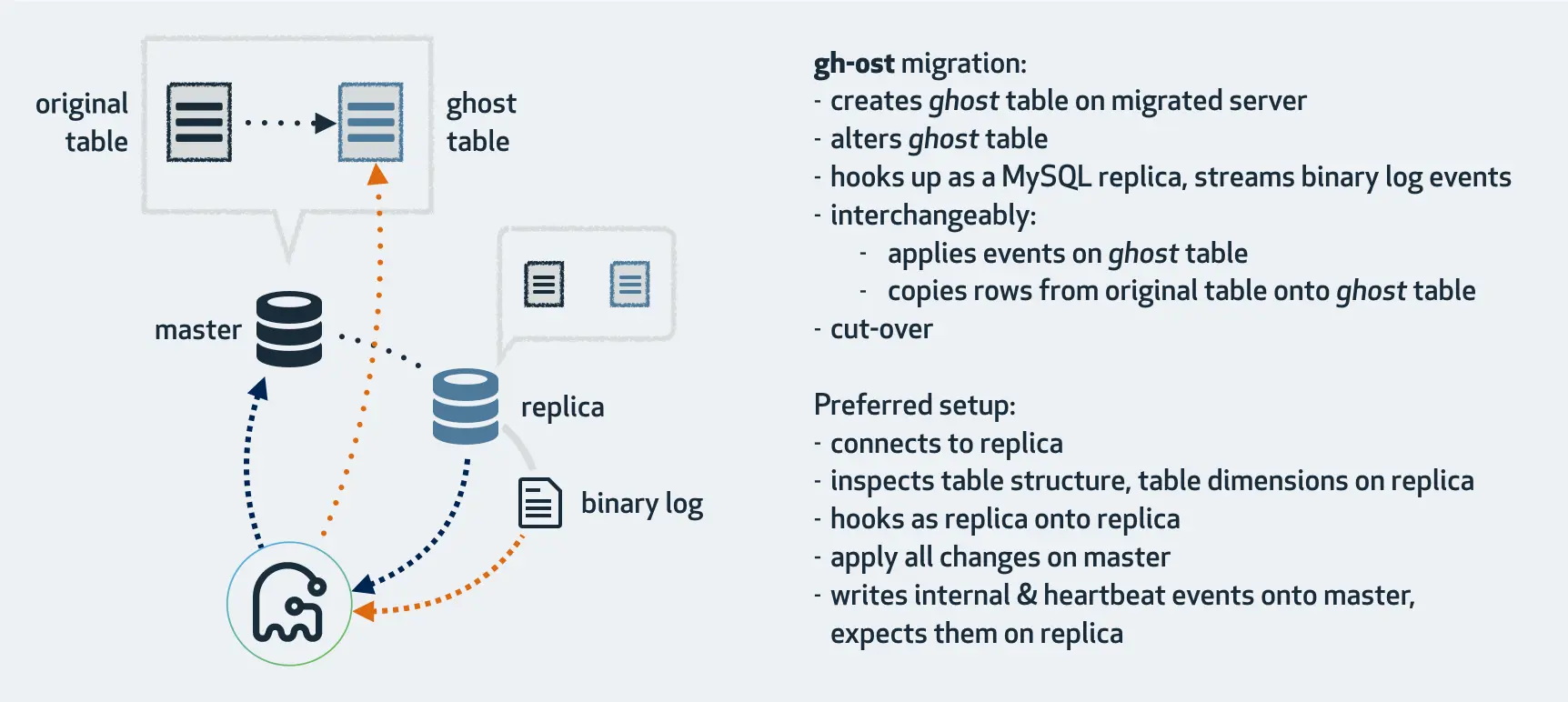
### gh-ost (GitHub Online Schema Transmogrifier)
- **Triggerless**, asynchronous approach.
- Captures data changes by tailing **binary logs** (requires **Row-Based Replication**, typically from a replica).
- Creates a ghost table, copies data in chunks, and applies DML changes from the binlog.
- Final cut-over is manual and auditable, requiring a brief metadata lock.
### pt-online-schema-change (Percona Toolkit)
- **Trigger-based**, synchronous mechanism.
- Uses DML triggers (`INSERT`, `UPDATE`, `DELETE`) to capture changes and apply them to the ghost table.
- Cut-over is typically an atomic `RENAME TABLE`.
- Compatible with a wider range of MySQL versions and supports foreign keys.
## 2. Feature Comparison
| Feature | gh-ost | pt-online-schema-change |
| ------------------- | ------------------------------------- | ----------------------------------- |
| **Triggers** | No (uses binlog) | Yes (adds for DML ops) |
| **Data Sync** | Async via binlog | Sync via triggers |
| **Master Load** | Lower (uses replica) | Higher (triggers on master) |
| **FK Support** | No (must drop & recreate) | Yes (`--alter-foreign-keys-method`) |
| **Replication** | Requires RBR, prefers replica | Works with SBR/RBR, runs on master |
| **Safety** | Advanced (hooks, throttling, checks) | Good (throttling, basic checks) |
| **Cut-over** | Manual, controlled, brief lock | Instant rename, less control |
| **Resumable** | Yes | Partial (if artifacts remain) |
| **MySQL Versions** | 5.7+ only | 5.5+ (older versions supported) |
| **Throttling** | Advanced (pause/resume via lag/hooks) | Basic (copy throttling only) |
| **Limitations** | JSON, partitions, FKs, triggers | Fewer; PXC has some constraints |
| **Replica Testing** | Accurate (binlog-based) | Limited (triggers don’t fire) |
gh-ost is optimized for **performance, safety, and control**, while pt-osc is better for **compatibility, simplicity, and FK support**. Choose based on your workload and infrastructure constraints.
## 3. Pros and Cons
| Tool | Pros | Cons |
| --------------------------- | ------------------------------------------------------------------------------------------------------------ | -------------------------------------------------------------------------------------------------- |
| **gh-ost** | - Low master impact
- No triggers
- Fine-grained control
- Resumable
- Designed for high traffic | - No FK support
- Requires RBR
- MySQL 5.7+ only
- More complex setup |
| **pt-online-schema-change** | - FK support
- Older MySQL support
- Simpler concept
- Mature and widely adopted | - Triggers add load
- Less control over cut-over
- May cause locking on high-write workloads |
## 4. When to Use
### Use **gh-ost** if:
- Your database is **write-heavy**, and you want to **avoid triggers**.
- You run **MySQL 5.7+** with **Row-Based Replication**.
- You need **throttling**, **replica testing**, and **interactive cut-over**.
- Foreign keys are **not present** or can be temporarily removed.
### Use **pt-online-schema-change** if:
- Your tables have **foreign keys** that must remain intact.
- You’re on **older MySQL versions** (5.5 or 5.6).
- Your team is comfortable with **triggers** and the workload is light to moderate.
- You want a **simpler setup** with less replication dependency.
## 5. Conclusion
Both tools provide **online schema change capabilities** with minimal downtime, but they serve **different operational needs**:
- **gh-ost** offers **lower production impact** and **greater control**, ideal for large, modern, high-traffic environments.
- **pt-online-schema-change** is better suited to **legacy environments**, **foreign key constraints**, or teams needing a **simple, proven solution**.
Your choice should be driven by **replication setup**, **schema features**, **performance needs**, and **team expertise**. For mission-critical systems with high write volumes, gh-ost is typically the safer bet—provided its prerequisites are met.