Bytebase and Delphix both show up under "data masking" searches, but they mask at different points in the data's life. Delphix masks a copy before it leaves production. Bytebase masks the query result while the data stays in production. This post covers what each does, where they overlap, and why regulated teams run both.
Bytebase vs Delphix at a glance
| Delphix | Bytebase | |
|---|---|---|
| Primary category | Test data management + static data masking | Database governance (change, access, SQL review, masking) |
| Masking approach | Static: rewrites a copy, at rest, irreversible | Dynamic: rewrites the result, at query time, reversible by role |
| Where it runs | Batch job against a virtualized/replicated copy | SQL Editor, on the live query path |
| Target environment | Non-production: dev, test, staging, demo, CI | Production (and non-production) live queries |
Static masking vs. dynamic masking
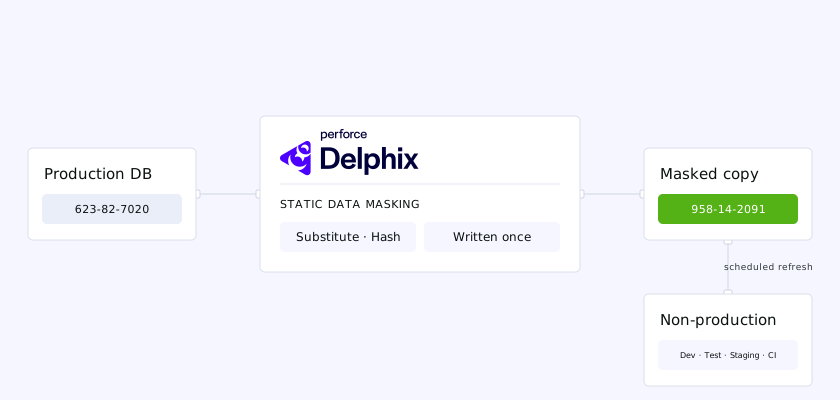
Delphix is a test data management platform. A job reads production (through its virtualization layer or a replica), substitutes, shuffles, or hashes the sensitive columns, and writes a sanitized copy for dev, QA, staging, CI, offshore teams, and demos. The transform is baked into the bytes: irreversible, no key or grant recovers the original value.
Two consequences follow. The protection travels with the data, so a backup, clone, or branch of that copy is also masked. The cost is paid once, at copy time, so queries against the copy run at full speed. The tradeoff is freshness: the copy is stale the moment it's cut, and refreshing means re-running the job. Preserving format and referential integrity across a whole schema, so masked foreign keys still line up, is the hard engineering problem Delphix solves.
Bytebase is a database governance platform: schema change management, SQL review, access control, and data masking in one workflow.
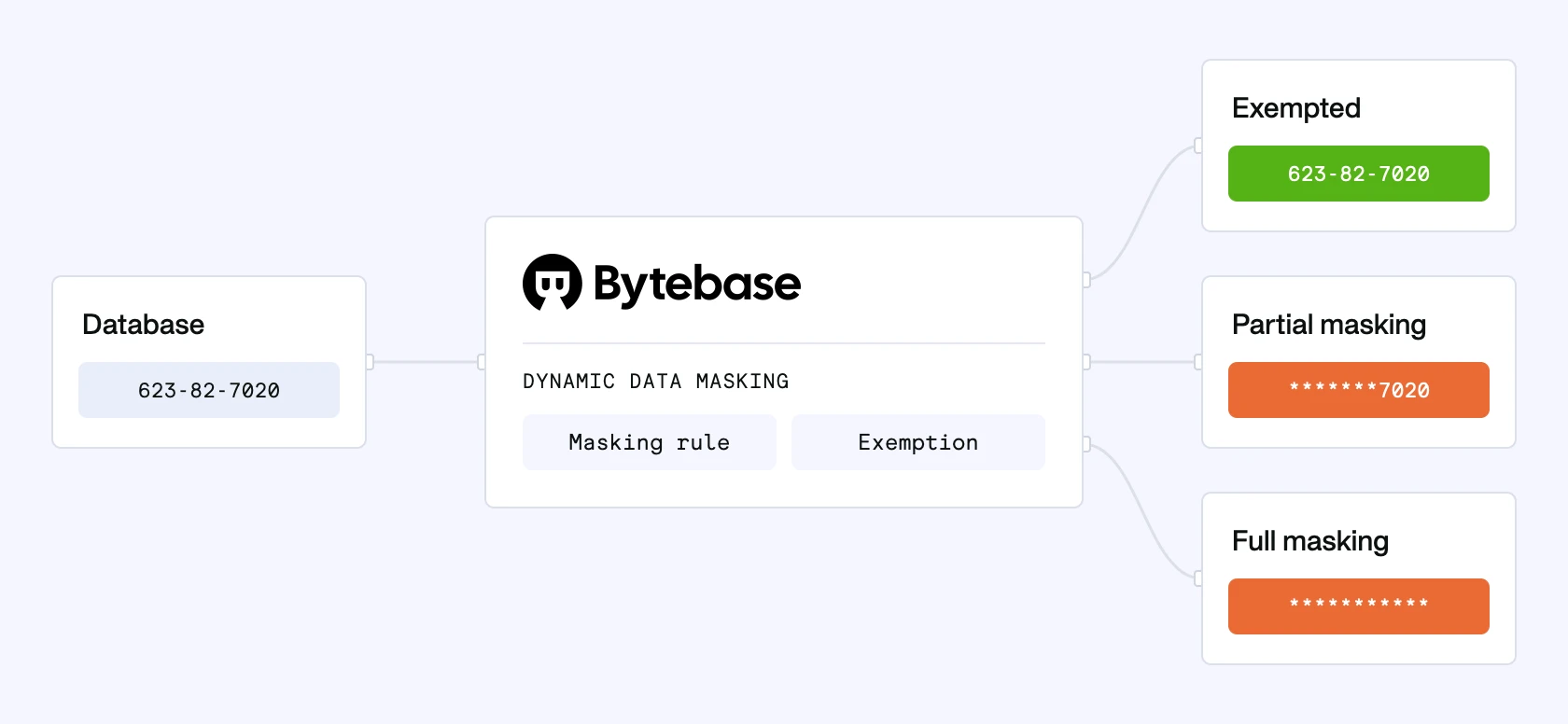
Bytebase Dynamic Data Masking masks at read time on the human and agent query path. An admin tags a column with a semantic type (email, phone, national ID, credit card); every read through the SQL Editor or an export applies the matching algorithm before the result leaves. The stored data is never touched, so a DBA and a support engineer running the identical query against the identical row get different results, because the masking decision is made per principal, not per copy.
The tradeoffs invert. The cost is paid on every query, not once. A backup or replica of the underlying database holds real values, because the mask applies on the way out, not the way in. Nothing is copied, so the data is never stale. Exemptions (a support engineer who needs cleartext for one ticket) go through approval and land in the same audit trail as every other access decision. The one gap: an application that connects to the database with its own connection string bypasses Bytebase and sees cleartext, same as any masking layer that sits in front of the engine instead of inside it.
Static masking and dynamic masking, working together
Delphix owns the non-production side: a scheduled job refreshes dev, test, and staging from production with masked data, so every downstream environment is safe by construction. Bytebase owns the production side: per-role masking on the live queries that never leave production.
We regularly see both deployed side by side at regulated teams (PCI, HIPAA, GDPR). Neither depends on the other; each covers the half of the estate the other doesn't touch.
Which should you choose?
- Delphix if the need is provisioning realistic, masked, referentially-intact data into non-production environments at scale.
- Bytebase if the need is governing what production queries return by role, alongside schema change management, SQL review, and JIT access.
- Both for a regulated team that needs safe non-production data and controlled production access. This is the common setup, not the exception.
FAQ
Is Bytebase a Delphix alternative? No. Bytebase doesn't virtualize, clone, or refresh non-production databases, and Delphix doesn't mask live production queries. Different core functions.
Does Delphix do dynamic masking? No. Delphix's platform masks copies for non-production delivery. Query-time masking of a live database, where the same row returns different values to different roles, is Bytebase's job.
Can Delphix and Bytebase run together? Yes, and we regularly see it at regulated teams: Delphix refreshes dev/test/staging from production on a schedule, Bytebase enforces role-based masking, SQL review, and access control on production itself.
What's the difference between static and dynamic masking? Static masking transforms a copy once, permanently, before it's ever queried. Dynamic masking transforms the query result every time, leaving the source untouched.
References
- Static vs Dynamic Data Masking: When to Use Which — the full breakdown, including backups, performance, and reversibility.
- Bytebase Dynamic Data Masking overview — how semantic types, masking algorithms, and exemptions work.
- SQL Review: from linting to governance — the SQL Editor and review workflow referenced above.
- Dynamic Data Masking tutorial — set up masking on your own database.