This post is maintained by Bytebase, an open-source database governance platform. We update the post periodically.
"Database DevOps tools" is not one category. It is at least eight, and teams usually shop for them one pain at a time: a failed migration sends you to CI/CD tooling, a leaked credential to secret management, an audit finding to access control. Below is a map of the categories, with a lead pick and alternatives for each, to help you get a sense of the options before you try them out.
What are the criteria? Every pick here is:
- Actively maintained - verified as of July 2026. Where a tool's maintenance wobbled this year, we say so.
- Database-focused - general infrastructure platforms appear only as context, not as picks.
- Adoptable on its own - every pick works standalone, so you can fix one category at a time.
Grouped another way, each category answers a governance question about your production databases: who can change them (CI/CD, SQL lint), who can access them (access management, data masking, secret management), and can you prove what happened and recover from it (observability, backup).
Start with the symptom you actually have:
| Your symptom | Category you need | Lead pick |
|---|---|---|
| Schema changes are applied by hand and nobody knows what ran where | Database CI/CD | Liquibase |
| Bad SQL keeps slipping past review | SQL lint | SQLFluff |
| Your restore plan is "the cloud provider has snapshots, probably" | Backup & recovery | Barman |
| Developers test against real customer data | Data masking | Perforce Delphix |
| You find out about slow queries from user complaints | Observability | Datadog |
| Everyone connects to prod as the shared admin user | Access management | see below |
| Database passwords live in config files and CI variables | Secret management | Vault / OpenBao |
| Your change, review, access, and masking workflows live in four separate tools | All-in-one | Bytebase |
Database CI/CD - Liquibase
As applications evolve, so do their schemas. Managing those changes with the same rigor as application code (version control, review, automated deployment) is the founding problem of database DevOps.
Liquibase (5.6k GitHub stars) is the veteran here. Developers version changes as SQL, XML, YAML, or JSON changelogs, track them with checksums, and wire deployments into CI/CD pipelines. It supports 50+ databases and gives you explicit control over migration ordering through its changelog and flow concepts. One licensing note for 2026: Liquibase 5.0 moved the Community edition to the Functional Source License (FSL), so it is free to use but no longer OSI-approved open source.
Flyway (9.9k stars) is the SQL-first alternative, simpler to adopt if plain versioned SQL scripts fit your workflow. Its commercial tiers changed shape in May 2025: Redgate discontinued the Teams edition, so rollback, code analysis, and drift detection now require the Enterprise license. We compare the two in depth in Flyway vs. Liquibase.
Alternatives: skeema (MySQL), schemachange (Snowflake), DACPAC (SQL Server).
Best for: teams standardizing migrations across many databases and environments. If you only run Postgres, evaluate the Postgres-native camp first. If you want migrations bundled with review, approval, and access control, Bytebase (all-in-one section below) covers this category too.
SQL lint - SQLFluff
Migration tooling controls how SQL gets applied. Linting controls what gets applied: catching anti-patterns before a human reviewer has to.
SQLFluff (9.8k stars) is an open source, dialect-flexible SQL linter. Designed with ELT applications in mind, it works with Jinja templating and dbt, and auto-fixes most of what it flags. It shines in analytics codebases; for OLTP migration review its generic rules are a starting point, not a policy engine.
Alternatives: squawk (1.1k stars, Postgres-specific, catches locking hazards like adding a NOT NULL column to a big table).
Best for: enforcing style and safety rules in CI before SQL reaches review. Bytebase (below) enforces its own 100+ review rules inside the change workflow rather than as a separate CI step.
Backup & recovery - Barman
When we first wrote this post, this section was titled "Missing": there was no obvious cross-engine pick, only per-engine specialists. That is still true, but the per-engine picture shifted enough in 2026 to name names.
Barman (3.2k stars), maintained by EnterpriseDB, is our lead pick for Postgres: centralized management of multiple servers, WAL streaming for near-zero data loss, and corporate backing that does not hinge on one person. That last point is the 2026 story. pgBackRest (4.2k stars), the long-time default answer, was briefly declared unmaintained in April 2026 when its sole maintainer lost sponsorship after the Crunchy Data sale; within weeks a coalition of sponsors (AWS, Supabase, Percona, and others) funded its revival, and releases have resumed. It remains a solid choice, but the episode is a reminder to check who funds your backup tool, not just its feature list.
For MySQL, Percona XtraBackup remains the standard for hot physical backups. WAL-G (4.2k stars) is the interesting cross-engine option: continuous archiving to object storage for Postgres, MySQL/MariaDB, and SQL Server from one tool.
General data-protection platforms (Veeam, Rubrik) cover databases as one workload among many. The market still misses a database-domain backup tool that treats all popular engines as first-class.
Best for: Barman if you run a Postgres fleet; WAL-G if you want one archiving tool across engines.
Data masking - Perforce Delphix
Data masking replaces real data with fictitious yet realistic data, so development and test environments stay useful without exposing customer records.
Delphix is the category leader, and its ownership is the 2026 update: Perforce completed its acquisition in March 2024, and the product now sells as Perforce Delphix. The core capability is unchanged: automated discovery and masking of sensitive data before it reaches non-production, at terabyte scale, with GDPR and HIPAA compliance in mind.
Alternatives: Tonic (synthetic data), Neosync (open source, anonymized prod-to-dev sync), Immuta (data warehouse focus).
Best for: shipping sanitized copies of production to every downstream environment. For masking at query time instead of copy time, see Bytebase in the all-in-one section.
Database observability - Datadog
Observability is how you find out about problems before your users do: metrics, logs, and traces feeding root cause analysis and capacity planning.
Datadog Database Monitoring covers Postgres, MySQL, SQL Server, Oracle, and MongoDB with query-level performance metrics, explain plans, and blocking-query detection, integrated into the same platform that already watches the rest of your stack. Priced per host, and the bill grows with your fleet, which is the most common complaint you will hear from its users.
Alternatives: Percona Monitoring and Management (open source, PMM 3 line) if you want the capability without the per-host subscription.
Best for: teams already on Datadog. PMM for cost-sensitive fleets.
Database access management
This is the other section originally titled "Missing", and the one where the gap has closed the most.
The incumbents are general PAM platforms: CyberArk, StrongDM, Teleport (20k stars for the open core). They broker and record access to all infrastructure, databases included, and their database depth keeps growing: Teleport audits individual queries and grants object-level permissions on PostgreSQL tables, views, and stored procedures; StrongDM records full query sessions. Those features land engine by engine, though (the object-level controls are PostgreSQL-only today), and the platforms' center of gravity remains the session, not the schema.
That database-aware layer is where the category grew. Just-in-time database access is the pattern to look for: no standing credentials, access requested per task, approved, auto-expired, and logged at the query level. Bytebase implements it natively at the database-object level; StrongDM and Teleport both added JIT workflows at the infrastructure level.
Best for: PAM if you need one broker for all infrastructure; a database-native tool if your governance questions are about schemas, masking policies, and change approvals rather than sessions.
Database secret management - Vault and OpenBao
Secret management stores and rotates database credentials, enforces access to them, and logs every read.
HashiCorp Vault is still the reference product, with two structural changes since we first published: HashiCorp moved Vault to the BSL license in 2023, and IBM completed its acquisition of HashiCorp in early 2025. The product keeps the HashiCorp name, but the Vault 2.0 release in April 2026 moved it onto IBM's versioning and support lifecycle. The license change spawned OpenBao (6.8k stars), a Linux Foundation fork from the last MPL release, API-compatible with Vault and adopted by Nvidia among others. A fork reaching that adoption within two years says plenty about how much the license mattered to teams.
Alternatives: Infisical (28k stars, developer-first, the most-starred project in this post).
Best for: Vault if you want the commercial ecosystem; OpenBao if you want the same API under an open license.
All-in-one - Bytebase
Every tool above governs one slice: Liquibase the changes, StrongDM the connections, Vault the credentials. Bytebase (14.3k stars) is the open-source platform that covers the change, review, access, and masking slices in one workflow:
- Database CI/CD with review and approval flows
- SQL review with 100+ lint rules enforced at commit and at execution
- Just-in-time access control with per-query audit logs
- Dynamic data masking for interactive queries, applied at query time
- External secret manager integration (Vault included) for credential handling
The change-side features (CI/CD, SQL review, GitOps) ship in the free Community edition; the security side (access control, data masking) is where the paid Enterprise plan starts.
The trade-off is scope: Bytebase governs database changes and access only. It will not broker logins to your servers, back up your data, or replace your monitoring. If your pain is specifically the database change-and-access workflow, one platform beats stitching four tools; if you need best-of-breed depth in a single category, the specialists above earn their place.
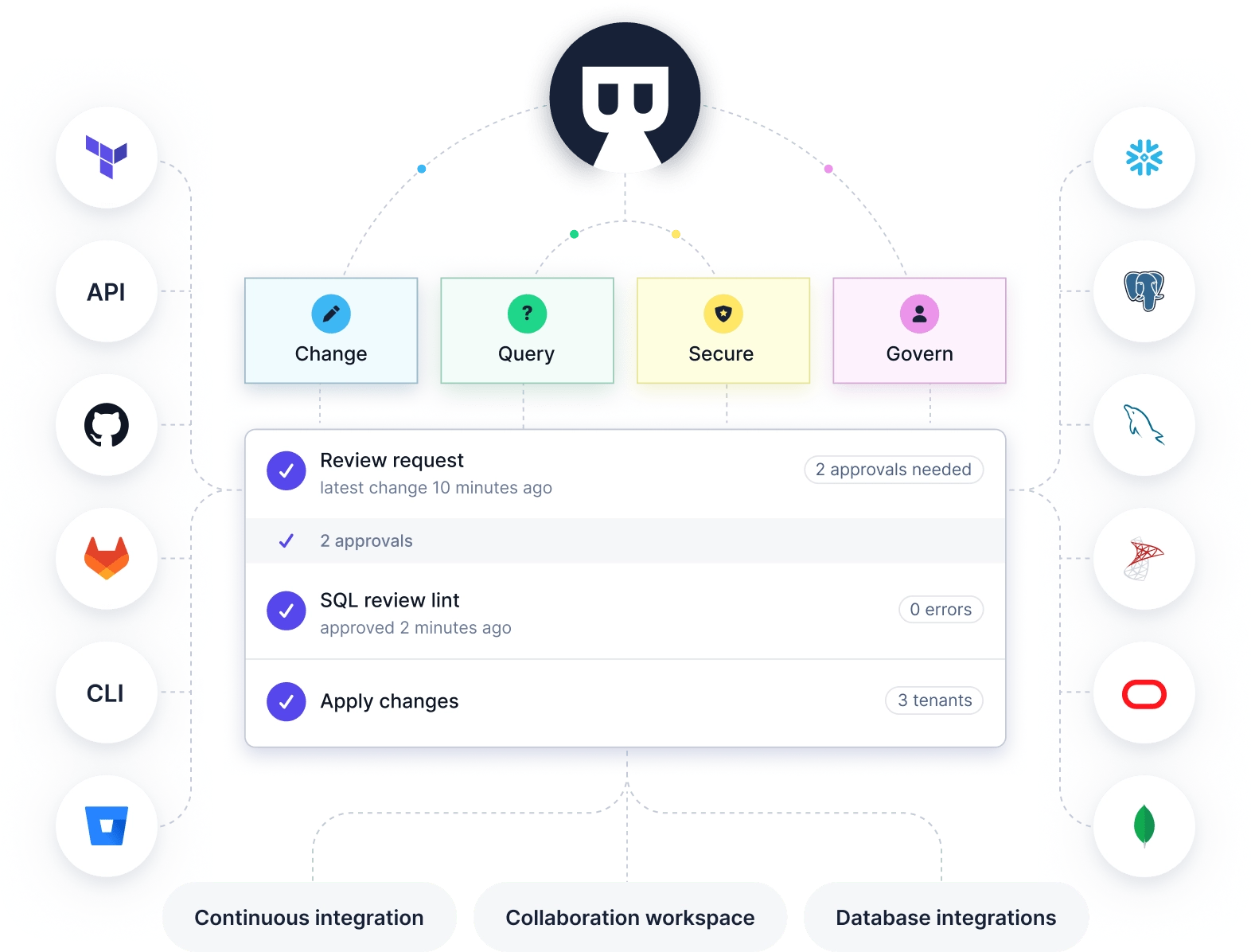
Most teams do not adopt all eight categories at once, and should not. Start from the symptom table at the top, fix the pain that is actually burning, and prefer tools that leave an audit trail as a side effect. Trying 2-3 options in your worst category will tell you more than any roundup, this one included.