Last time we addressed What is Database DevOps, today we are extending the topic to Database DevSecOps.
Database DevSecOps is the practice of integrating security throughout the entire database development lifecycle, much like how DevSecOps evolved from DevOps. The "shift-left" idea translates directly: instead of a security review that happens after the fact (or an audit that happens once a year), security controls are embedded in the workflow that every database interaction already flows through.
The Security Role
In database DevSecOps, besides the typical Developer and DBA roles, security engineers join the party:
- Developer - Build and deliver ASAP.
- DBA - Prevent database outage.
- Security engineer - Prevent data breach.
By looping in the security engineers, we also face a classic dilemma in the database domain.
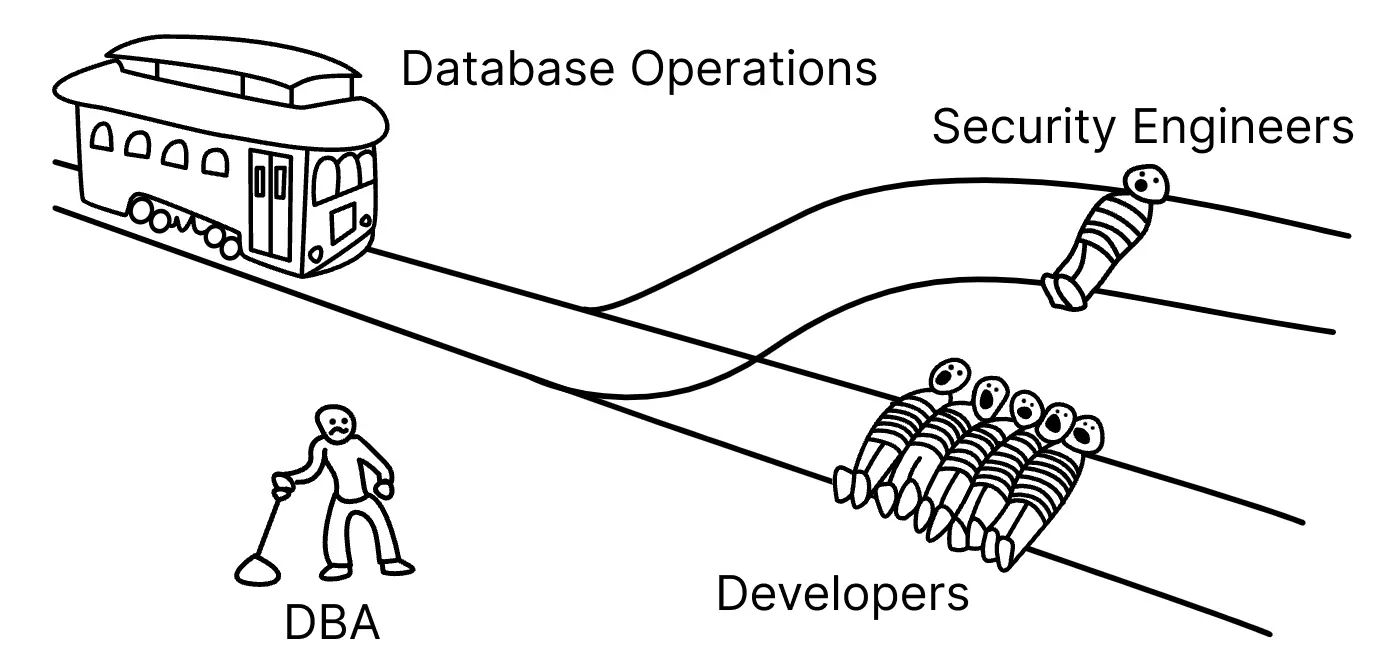
If DBAs give developers too much freedom, security gets breaches; if they impose overly restrictive controls, developers get frustrated and route around them, which is worse than either. The resolution is not a compromise slider but a design principle: make the secure path the fast path. Every control below follows it.
The work then decomposes by access path, because each human-to-database (and now agent-to-database) route has different threats and different controls.
Path 1: Schema Migration
The threats. An erroneous DDL that locks a hot table is an availability incident; a subtly wrong one (dropping a column, loosening a constraint) is a data-loss incident; and the deployment pipeline's own credentials are among the most privileged secrets in the company.
The controls. Automated SQL review runs as a security gate, not just a style check: rules against DROP, unbounded rewrites, and permission grants execute on every change, before human review. Separation of duties is enforced by the workflow: the author cannot be the approver, and the record proves it, which is precisely what a SOC 2 or SOX auditor samples. The pipeline itself deploys with a scoped identity, so compromising a developer account doesn't yield DDL rights on production.
Path 2: One-off, Ad-hoc Change
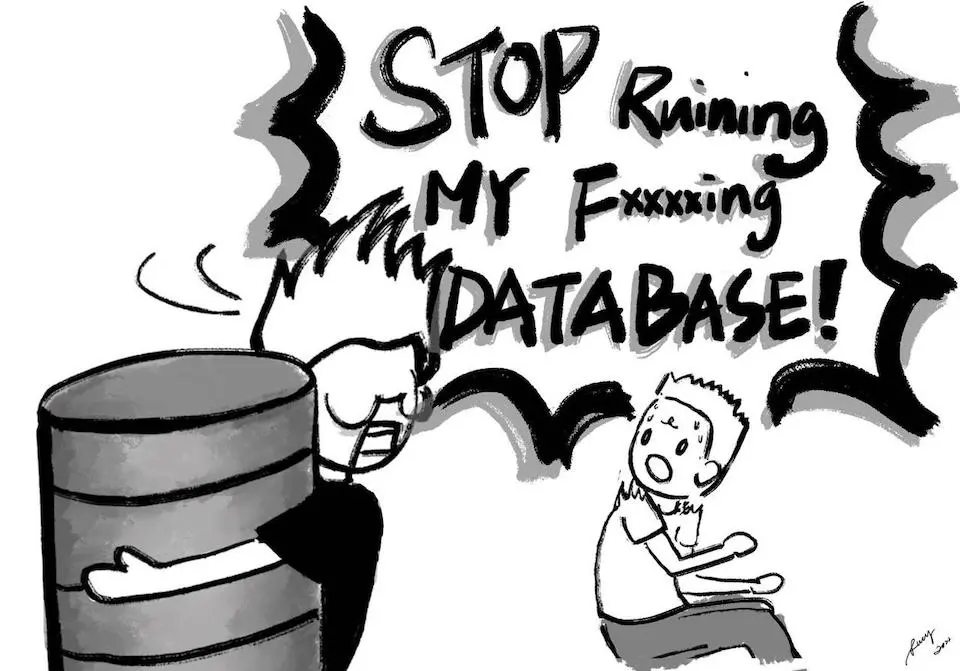
The threats. The urgent production data fix is the highest-risk statement in the ecosystem: written under pressure, tested nowhere, and historically executed from a personal SQL client with standing write access. The failure modes are folklore because they keep happening: the forgotten WHERE, the right statement on the wrong environment.
The controls. The fix request states the SQL and the justification once, in one system, with no copy-paste hops between ticket and client. Before execution, an affected-row estimate catches the unbounded update; a prior-state snapshot of the touched rows makes the change reversible without a full restore. Four eyes are mandatory precisely because the change is urgent: pressure is when review earns its keep. We wrote up the full pattern in How to Handle Ad-hoc Database Data Changes.
Path 3: Query Data
The threats. Read access leaks more data than write access corrupts. Shared read-only credentials in desktop clients mean no attribution; unmasked PII in query results means every debugging session is a privacy event; and a SELECT * export is exfiltration with a legitimate-looking start.
The controls. Access is granted per person, at statement granularity, with just-in-time elevation instead of standing rights. Sensitive columns are masked in results by default, unmasked only by role and approval. Every executed query lands in an audit log with user, statement, timestamp, and resource, which is the four-field record breach investigations and compliance audits both ask for. Export is a separately-permissioned action, not a free byproduct of read access.
Path 4: AI Agents
The 2024 version of this post listed three paths; there is now a fourth. Coding agents write migrations, and MCP-connected agents query databases directly. An agent inherits every risk of paths 1-3 at machine speed, plus one of its own: prompt injection can turn a read-only helper into an exfiltration channel.
The controls are structurally the same, which is the good news: give the agent its own identity (not a borrowed human credential), scope it with the same statement-level permissions and masking, and route its writes through the same review workflow as a human's. A governance layer that only understands humans will miss the fastest-growing class of database clients; see Governed MCP vs. Raw MCP for the deep dive.
Summary
Bytebase implements the controls above as one workflow: SQL review and GitOps on the change paths, access control, dynamic data masking, and audit logging on the query path, with the policies themselves codifiable via Terraform.
Database DevSecOps is DevOps with the security engineer's veto built into the pipeline instead of bolted onto the calendar. Enumerate the access paths, put a control at each one, and make the governed route faster than the workaround; the trolley problem dissolves when nobody needs to pull the lever.